a complete history of the brisbane youth music scene · part 5 of 5 · 2025 to 2026
What Comes After
chapter eight, then the afterword · reading time about 12 minutes
Chapter 8: Casualty
This chapter is being written from inside the events it describes, which is exactly the failure of objectivity Charles Bean would have approved of, so let the record show what 2026 has actually contained.
In February, this magazine woke up properly for the first time in a year by declaring the scene dead in print, loudly, and being argued with, which in hindsight was the first sign of life; nobody argues with the obituary of something that's actually gone. Through autumn, the evidence started accumulating that the obituary was premature. On 9 April, Breakbone put on its own gig, The Big Break, an all ages show split across two stages, with Dublin Rose, Elle Payne, Fucken Oath and Heavy Liquid on the bill, with fifty five people through the door, scene veterans from the Casualty days standing next to kids at their first ever show. On 25 April, Babylon Music Events, run by two young organisers named Zac and Lily, staged an all ages festival at the Sherwood Magpies clubhouse. And on 15 May, four bands, Mandala, Ember, Axis and Rupture, hired Coorparoo Hall themselves, ran their own door, took no grant money from anybody, and packed out May Metal Mayhem, seven years almost to the week from Casualty's founding. That same month Findaway, by now one of the biggest bands in the scene, played their comeback show at the Warrego Revue after months away writing and recording. Nobody at any of these shows needed the cycle explained to them. A scene that had died in 2025 was doing the only thing this scene has ever done with death, which is fail to take it personally.
Guy Di Mattina of Findaway, interviewed in September 2025, had already called it. The scene had a lull, he said; everyone was in Year 12, everyone was busy, and now they'd graduated they had time to do shit again. That is the engine of fifty years of this history in three sentences, the lull is the cohort studying, the revival is the cohort coming back, and the death only becomes permanent if the next cohort never finds out the door exists. The old hands know it too. Arran McKenzie of Piss Off, the elder statesman of the revival era, has said plainly that once you turn nineteen or twenty it gets a little bit weird hanging around all ages gigs, give us a year or two and you won't see us at them at all.
The all ages scene is the only scene on earth designed to lose every member who loves it, on a fixed schedule, forever.
It survives anyway, or it has so far, by one mechanism only, somebody slightly older handing the door key to somebody slightly younger before they go.
The torch is mid-handover as this goes to print. The bands of the moment, Rupture and Ember and Whitt's End and Findaway and a dozen others who will have changed names by the time you read this, are booking their own halls in the Casualty tradition, many without ever having seen a Casualty show. Then, on the 13th of June, Deadtrigger came back. Punk in the Park was its first gig in eight months, four hours on a patch of public concrete at Thornlands skatepark with no grant and no YMCA behind it, and when the rain killed the amps the whole show finished on a single power cable. More than a hundred turned up, and Bleed The Freak's singer closed the night off by saying the only sentence this scene has ever run on, that you don't need bars to have a good night, you can go to your local park and play. The 90s proved the scale works; the festivals got big enough to put the scene back on the map, then too big to hold without the permits and the policing that come with permission. So you go smaller and you just hold it. Deadtrigger already did, on a patch of public concrete with no grant behind it, and the park gigs had been doing it all along; the question was never whether Paddo can host a festival, it is who is going to hold it?
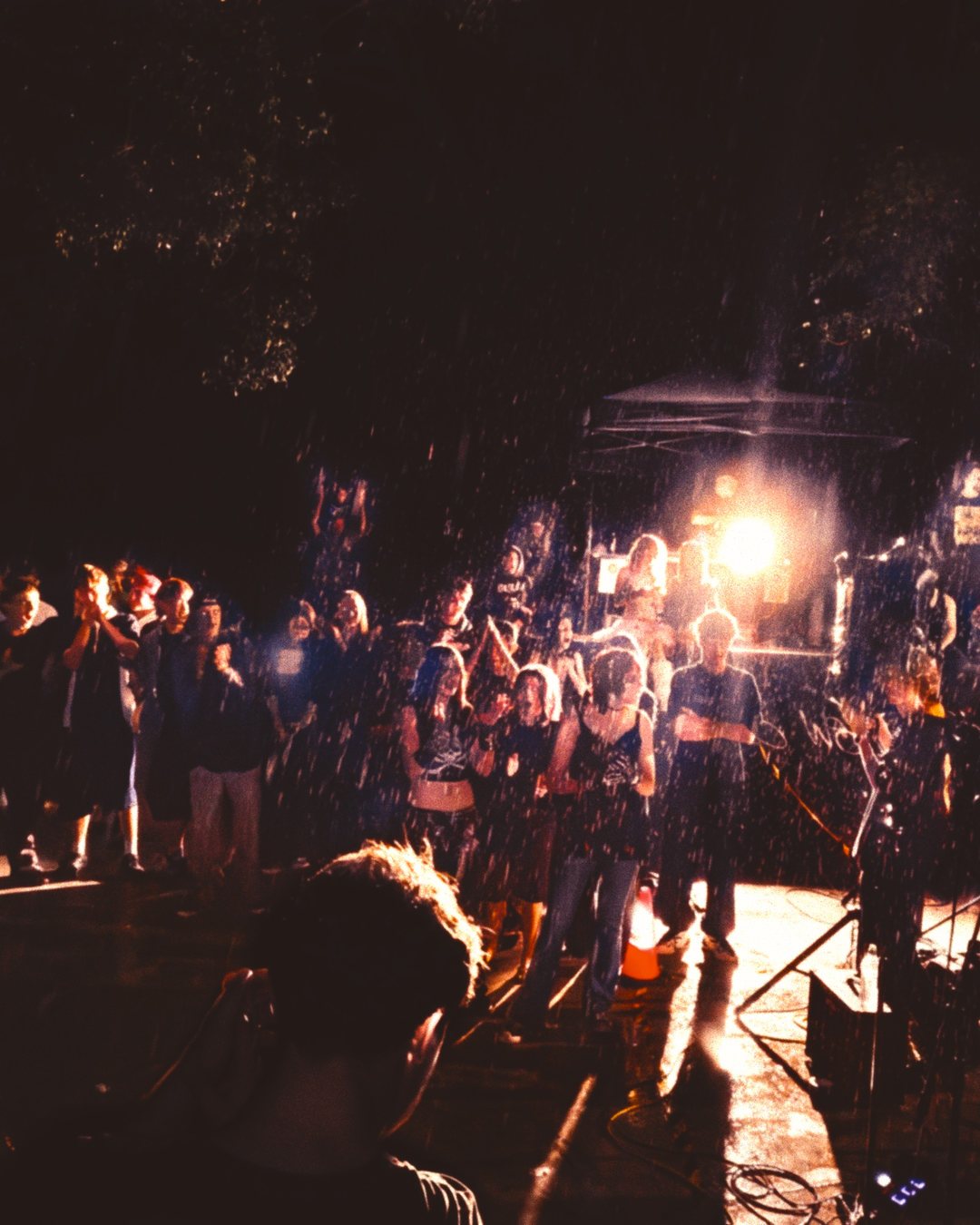
This magazine, in September 2025, interviewed Pricey, the guitarist who founded The Chats and walked away from them, a bloke who has played the stadiums and the festivals and chose a Norman Park bowls club on purpose; he put it plainer than this whole book manages. Fuck the ticketing companies, he said, let the artists just be the artists. It is raw, it is fun, and that is how we all start, a touring pro looking out at a bowls club of forty kids and parents and naming from outside it the exact thing fifty years of this scene has been built on. It was the same moment the first wave had fifty years ago and the Casualty kids had in 2022, played again for people who had never seen either; Casualty lit it in 2019, Project Punk and Antidismal carried it in 2022, Deadtrigger took it to the bayside in 2023, and the kids in that skatepark are the wave after that, the door handed down the line one more time. New and old organisers, Spark Foundation, Schema Collective, Worldrot, Imagine Music, are filling pieces of the space the trinity left, even if none of them yet feels like the youth running it for the youth. A larger festival, Where We Belong, on 27 June 2026, pulled the bigger bands onto a bigger stage; the bands took to the scale of it even as they were the first to call the organising iffy, the running order tight enough that Findaway and Whitt's End ran dead against each other on different stages. It could host the scene. It just was not run by it. The gigs have drifted toward licensed rooms, an Afterdark in Milton rather than a hall with a hired key. Rooms like that can host a gig; they are not homes for the scene. They wear 'community' the way a landlord wears it, and underneath there is always the pitch, some pipeline to the 'industry', an industry that died when physical music died, sits a thirteen hour flight away, and does not know your name. Fifty years of this record say the same thing; nobody here ever needed that permission. And a new organiser called Run Amok has appeared on the bills, with Bubblegum Haircut and Night Boys on its gigs; anyone who knows whose drumming carries Bubblegum Haircut can draw their own conclusions about who might be behind it. The scene talks about Kaleb like he went quiet, and the bills say otherwise. Antidismal went genuinely dismal, the trigger got pulled on Deadtrigger and it instead came back bigger, and the man who named his label Casualty seems to have felt he became one himself, a casualty of his own success; he is also, on the quiet, still moving. The Substation stands empty with the 2032 Olympics works circling it, and some of the bands already talk about chaining themselves to it if the wreckers come, which would be the most Brisbane ending imaginable, the city tearing down the scene's holy ground for a stadium, fifty years after it tore down Cloudland for flats.
When Andrew Stafford closed the tenth-anniversary edition of Pig City he wrote that the scene was now stronger than it ever was, and that documenting it was 'for another, younger writer'; he'd kept his own book a snapshot on purpose, and he warned that the faint echo of history repeating itself might make for eerie reading. This book is that attempt, made by someone who got to the scene late, loved it anyway, watched it die and is watching it come back. The Saints' wave died in 1977. The emo wave died in 2011. Kaleb's wave died in 2025, and the kids hiring their own halls this winter are proof of what the whole record keeps saying, that the scene always existed, and that it only ever needs two things to keep existing, somebody letting the new people in, and somebody writing it down. Each wave remakes the scene in its own image, to fit whatever the kids running it need it to be, and each time the gap between one wave dying and the next one starting gets shorter, until the death and the birth almost blur into each other. We are on the cusp of that now, and up close it looks like nothing more than a few kids in a hall on a winter night. That is what history looks like before anyone has decided to call it that.
Every torchbearer in this book left a message behind in their own words. Batsy said a scene that doesn't document itself with empathy just disappears. Kaleb said the whole mission was somewhere safe to go on a Friday night. George said have fun but don't ruin other people's fun. I used to think I was an outsider to all of this, a misunderstood genius, a pariah, and looking back at how my friendships fractured, a fair share of that was me doing it to myself. It doesn't much matter anymore. The people who inspired me aren't carrying the scene now, and the people I once pictured carrying it with are gone, so whether anyone likes it or not, including me, the carrying has landed here. How long I've been doing it and what I've done speaks for itself, and it isn't really the point. The Saints felt the doubt too and went ahead anyway, and the going ahead is what made them The Saints. The first edition of this history ended on a line I'll say again, because the two years since tried to prove it wrong and failed: a subculture is not a disposable TikTok aesthetic, something you put on for a season and scroll past. It is a fifty year old movement with a door in it, and the door is still open.
I close this by saying what those who inspired me said, in my own way, for the scene as it is today and tomorrow. When the thing you want to do is so strong it feels like a need and not a want, do it. You will cop naysayers, wannabes, haters and bullies. There will be pain in it. In this town the jury is rigged, but the people always know the truth. It's when you're in your bedroom, hours into a burnt out second hand guitar, no money, drama raging, half your mates not talking to you, and you still have the dream. It's when you're in a community hall with that thick, dense twentieth century air, people trickling in, the lights going out, the first band coming on, and the sound somehow soothing the wounds inside. It's when you're up in front of a crowd of mutuals you've only ever seen as profile pictures, your mates, your mentors, and the venue is shit and the aura is off and you fluff your parts, and afterwards the people who actually matter, people you haven't spoken to in months and people you're speaking to for the first time, tell you it was awesome. It's love and violence, all rolled into one. It's being stranded by your parents, your school, the people you thought understood you, stranded by everyone and everywhere you once knew, and then the music comes on, the right people are there, and you're home, the real one, doing the thing you love with the people you love.
You are not getting any younger, only older. This is your moment, and if you do not use it you will regret it for years, so quit waiting around and make it happen. Document, distribute, demonstrate. You're the scene, and you're the ones making it.
Afterword
An encore is the one song you held back. This is mine.
Every anthem you have ever screamed with strangers started as a letter to one person. That is the whole secret of the form. Somebody wrote somebody else a message they couldn't say out loud, hid it inside a melody, and a thousand kids who never met either of them found their own names in it. The scene runs on the same law. It is the first place this city hands a kid to say the thing there is no other way of saying; you carry it into a hall through a borrowed amp, and the moment the crowd gets it, it stops being only yours.
I have one of those songs. There was a night it was supposed to be played, for one person, and the night went wrong, and she never heard it. That's all the detail the record needs. Sometimes a person comes along and makes you believe; the rest of the time, the believing has to come from this. And some of what I went looking for turned out to be standing next to me the whole time; it took me two years to notice. If you carry an unplayed song too, and I know some of you do, bring it. The scene keeps the unplayed ones safest of all, and somebody here will hand you an amp.
Here is where it goes, said the only way this book is allowed to say anything, as fact. The next wave is already forming, bayside or northside or a suburb this book has never printed, and it will not matter which, because from a stage this city looks the same in every direction. The kid who runs it hasn't started a band yet, or she has, and it's already broken up once, which is better. The halls will be new halls. The paper will be this paper. Breakbone will be there with the light on, writing it down while it's still warm, because the alternative is Chapter Seven, and we don't do that one twice.
Make them understand, or they'll forget.
There's a night coming, some hall, some park, where the crowd goes back further than I can see, and everyone in it knows exactly what this scene is, because they'll be holding the record of it. Maybe you'll be there. Maybe you're the chapter after this one.
I hope, I think, I know.
sources and notes · the record's receipts · one apparatus, the Bean move
Sources and Notes
An official history is supposed to show its working; that is half the point of calling one official, and Charles Bean would have understood. Every claim in the five parts was checked before it printed, and where two good sources disagree the text flags the conflict instead of smoothing it over. The full working ledger stays in the drawer; this page is the reader's copy.
the tiers
First-hand accounts and primary documents outrank the printed record; the printed record outranks the web; community memory (threads, group posts, single-witness stories) is lowest tier and is flagged wherever it stands alone. People are named here only where they are already credited in the parts or gave their accounts on the record.
primary scene documents and first-hand accounts
- Warwick Vere, oral history (State Library of Queensland) and his direct account at the Rocking Horse counter
- Braxton Hunt-Nissen, direct account (the Deadtrigger origin; the 13 Jun 2026 Punk in the Park return)
- Kaleb Collings, direct account (Casualty Records; the hoax corrected; the true exit)
- Arran McKenzie, direct account (the Piss Off founding and album arc)
- Guy Di Mattina, interview, 24 Sep 2025
- Josh Price, direct interview
- A Radio Birdman-era eyewitness account, consent-guarded, rendered third person
- Community submissions to this edition; Big Greg (#001, credited) and one anonymous (#003)
- Geoffrey Walden, PhD thesis, QUT 2003 (the policing lineage into the Fitzgerald Inquiry)
- Scott Regan, 'The Brisbane Sound', PhD by Creative Works, QUT 2019
- UQ Fryer Library FVF518, the 4ZZZ ephemera finding aid
- State Library of Queensland, John Oxley Library, Paul O'Brien Collection (Acc. 29127)
- Radio Times, October 1985 (4ZZZ's own zine, read off the scan)
- 4ZZZ's organisational record; media kit, annual report, strategic plan, station policy
- The CJC's published record of the 1996 Market Day riot
- The Saints' 1976 to 77 Sire Records press kit
- The 2022 Casualty mini-documentary; the 2023 Peace Centre and Shock Value documentaries; the Shedfest documentary; the BUMS 1990 to 1993 documentary
- Brisbane City Council heritage citations and the Cross River Rail heritage register
books and articles
- Clinton Walker, 'Stranded: The Secret History of Australian Independent Music 1976 to 1992'
- Andrew Stafford, 'Pig City: From The Saints to Savage Garden'
- Tristan Clark, 'Orstralia: A Punk History 1974 to 1989'
- David Nichols, 'The Go-Betweens'; Robert Forster, 'Grant & I'
- Jon Savage, 'England's Dreaming'; Legs McNeil and Gillian McCain, 'Please Kill Me'
- Brian Epstein, 'A Cellarful of Noise'; Paolo Hewitt, 'Getting High: The Adventures of Oasis'
- Heather Anderson, 'People Powered Radio'
- Alan Knight, 'Ratbags, revolutionaries and free speech'; Whitton, 'Political Football'; Dickson, 'Moon Dance Memories'
- Jodie Taylor (two papers); Ben Green; Gilfedder; Carah and colleagues; Volz and Faulkner; the Journal of Sociology's Market Day record
- UQ Contact Magazine, 'Tracing the Evolution of Brisbane's Punks and Goths' (2023)
- Museum of Brisbane, 'Deep Reads' (2024); Ed Kuepper, Australian Music Vault interview (2017); MOJO issue 132
- Brisbane History Group, the Caxton Street photo study (2025)
radio, web and transcripts
- Nineteen documentary and interview transcripts, auto-captioned and used with care
- Punk Journey interviews (Alan Bamford, Bruce Milne, Mark Ivey); the Paul Taylor and David Pestorius interview
- 'Sound As Ever' podcast; 'Revolution Rock' prospectus; John Willsteed's 'Stranded' documentary treatment (2015)
- Two 2026 vox-pop gig transcripts (18 Apr; 27 Jun), auto-transcribed and flagged as such
- scenestr; ABC and Guardian venue features; Humanitix event records; runamok.net.au; the archived Antidismal site
- Ten Reddit threads and nine Facebook threads of venue and scene memory; lowest tier, flagged at every use
the zine's own record
- The 2024 first edition of this history, corrected rather than repeated
- Breakbone's back issues, gig reviews and interviews, 2024 to 2026
- The editor's own photography, notebooks and research dumps, kept since day one
See an error, hold a document this record needs, or remember it differently? That is not a problem, that is the next edition. Add your chapter or write in; corrections land in days, not decades.
end of part 5 the history is complete; the scene isn't
Add your chapter › Start again at Part 1 › Back to the History ›